Mini Split Installation in McAllen, TX
A new system here will heat from December through January and cool from February through November every year. Tell us about the house, and a licensed contractor who covers Hidalgo County will get in touch.
Tell us about the job
It takes about a minute.
McAllen asks for cooling most of the year
Your mini-split works February through November here. That's ten months of cooling against afternoons that average 97°F. December and January bring the only real call for heat, and even then nights average just 51°F. That's a light, short heating season next to a long, hard cooling one.
A new system has to lean toward cooling capacity, with heat held in reserve for those two cooler months. Any mini-split heat pump built since January 2023 has to meet 14.3 SEER2 for cooling and 7.5 HSPF2 for heating. Look for those numbers on the unit you're getting. Hidalgo County has logged far more damaging wind events than winter storms over the past ten years, so ask how the outdoor unit will be mounted and secured before it goes in.
- 2 months
- December through January, your system heats
- 10 months
- February through November, it cools
- 51°F
- the average winter night it heats against
- 97°F
- the average summer afternoon it cools against
NOAA nClimDiv, 1991–2020 normals
Texas requires HVAC contractors to hold a state license.
The Texas Department of Licensing and Regulation tests and records the contractor, not the job itself. That license stays with the business across every project it takes on, so it is the contractor behind the work who is accountable, not a certificate tied to your mini-split alone.
In most cities and counties, installing a mini-split needs a permit from the local building office, and an inspection once the work is done. That inspection is what confirms the installation at your address was done right, separate from the license the contractor already holds.
Source: Texas Department of Licensing and Regulation
- Is a mini split worth it?
- For most homes here, yes, because a mini split runs both the heat and the air conditioning off the same outdoor unit, and cooling is what this area needs most of the year. It handles February through November without strain and still keeps a room warm on the cold nights from December through January. It also heats and cools with electricity, which is how most homes here are already set up. The main case against one is a house with several rooms that all need coverage, since each zone needs its own indoor head or a system sized for that many.
- How many rooms can a mini split cover?
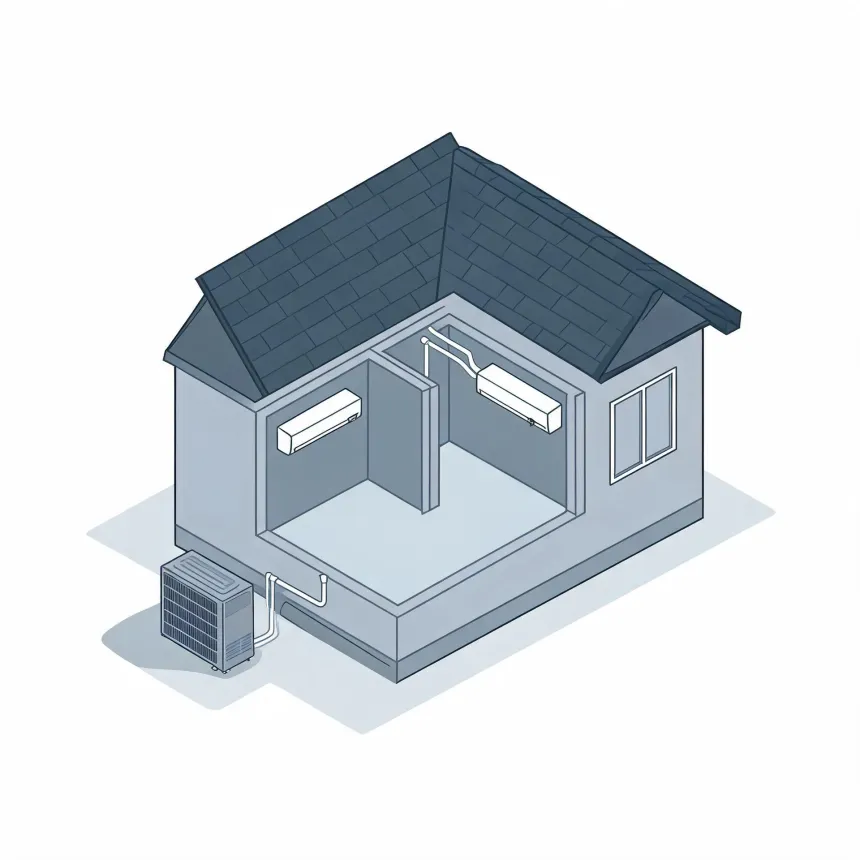
- That depends on the outdoor condenser, since each one is rated to run a set number of indoor heads. Each room gets its own indoor unit and its own thermostat, so you can heat or cool one room without running the rest. A contractor will size the system to the square footage and layout of the house, since too many heads on one condenser will leave each one underpowered.
- Can a mini split heat a whole house?
- It can, if there's an indoor head in each room or the layout is open enough for a few heads to cover it. A mini split heat pump pulls heat from the outside air rather than burning fuel, so it works fine down to the winter lows this area sees. The harder question is coverage, not capacity. A contractor can walk the house and say how many heads it needs to heat every room, not just the main living area.