Signs your ducts need cleaning in San Antonio, TX

Match me with a pro

You're probably searching this because something changed. Dust showing up again right after you clean, a musty smell when the air kicks on, more sneezing than usual, maybe you've seen the vents themselves looking dirty. Any of those can point to ducts that need attention, but what's actually going on inside yours depends on your system, your house, and how long it's been since anyone looked. That's not something to guess at from a search result. A local contractor who deals with duct systems around Bexar County all year, in homes running the same kind of equipment yours does, can tell you what's really there and what it means for your air. Answer a few questions about your home and you'll be matched with one contractor suited to the job, not a list of companies competing for your number. They'll reach out and take it from there.

The signs are what you already noticed: dust that resettles within days, a musty smell when the system starts, more sneezing or coughing indoors than out, and vents with visible dust or a dark ring around them. Ducts carry air through the house, and whatever is sitting in them gets pushed into every room every time the system runs. Pet hair, dust, and in older duct runs sometimes a bit of mold, all stay put until airflow stirs them loose. San Antonio summers are long and muggy, and a system that runs for months at a stretch moves a lot of air through those same ducts, so whatever is built up inside gets circulated more, not less. If you've had rodents or a water leak near the ductwork, or you can't remember the last time anyone looked inside them, that is also reason to have them checked. None of this tells you how bad it is. Only a look inside the ducts does that.

Why does duct buildup show up faster in some San Antonio homes than others?

  • Half the homes here were built by 1990

    Half the homes in Bexar County were built in 1990 or earlier, per Census data. Older duct runs have had more years to collect dust, so check yours whether or not you've had it done before.

  • Heat runs November through March

    Cooling runs April through October here, about seven months a year. That's seven months of air moving through the same ducts, carrying whatever is sitting in them into every room.

  • Cooling runs April through October

    Heat only runs November through March, about five months. Dust and debris that settled over a long summer often gets stirred up the first time the system switches to heat.

ACS 2020-2024 · NOAA nClimDiv 1991-2020

Signs that mean clean the ducts

Dust back on the same shelf a day or two after you wipe it down is the clearest sign. A musty smell when the system first kicks on, especially after the unit's been off for a while, points to the same thing. If you pull a vent cover and see a dark ring or a layer of dust on the inside, that's buildup already moving through the house, not just sitting at the register. More sneezing or coughing indoors than when you're outside is worth paying attention to as well, especially if it eases when you leave the house for a few hours.


Signs that point somewhere else

A single dusty room usually means a closed vent, a loose duct connection, or a return that's drawing air from an attic or crawlspace, not a whole-house buildup. A new smell that shows up only once, after the system's been off for days, often clears on its own once the air's been moving a while. Higher bills with no change in comfort usually trace back to the unit itself, a dirty filter, a weak capacitor, low refrigerant, not the ducts carrying the air. Allergy symptoms tied to a specific season point to pollen, not what's inside the ductwork.

An older man with gray hair and a beard stands in a dimly lit entryway wearing a dark hooded coat dusted with snow, with a lit table lamp, framed picture, and front door with glass panels behind him.
An older man with gray hair and a beard, wearing a dark snow-dusted jacket and scarf, stands smiling in a dimly lit entry hall with a lamp, wooden front door and staircase behind him.
A gray-haired bearded man in a dark coat with snow flecks on the shoulders stands just inside a dimly lit home entryway, with a lamp, framed pictures, sofa and candle-style lights in the background.
An older man with gray hair and a beard, wearing a dark coat and scarf dusted with snow, stands in a warmly lit home entryway with an arched doorway, lamps, and a living room visible behind him.

Your system has two sides. Supply ducts push conditioned air out through the vents in each room. A return duct pulls air back in, usually through one or two large grilles, and sends it across the filter before the system reconditions it. That return side does most of the dirty work. Air crosses the filter, but anything that slips past it settles in the duct just behind, out of sight. None of this happens constantly. The blower runs only when the thermostat calls for heat or cooling, so dust inside the ducts moves in bursts, not all day. In attic runs, which are common here, the duct is often flex duct with a ribbed inner liner, and that ribbing catches more dust than smooth metal would. A real cleaning job works both sides, loosening debris with a brush or air tool and drawing it out through a vacuum at the main trunk. Sealing any gaps found along the way matters just as much, since a leak in the attic or crawl space will keep pulling dust back in.

How Air Moves Through Your Ducts

  • Supply ducts push air out at the vents while a separate return duct pulls air back to the system, and buildup can sit in either side without showing the same way.
  • The return is usually the bigger problem because it pulls air across a filter and whatever gets past that filter settles in the duct behind it.
  • A blower only moves air when the system calls for heat or cooling, so dust inside the ducts stirs in bursts rather than all day long.
  • Flex duct, common in attic runs, has a ribbed inner liner that catches more dust than smooth metal duct does.
  • A duct cleaning job loosens debris with a brush or air tool and then pulls it out through a vacuum connected at the main trunk line.
  • Sealing any gaps found in the ductwork during the job matters as much as the cleaning, since a leak can pull dust back in from the attic or crawl space.
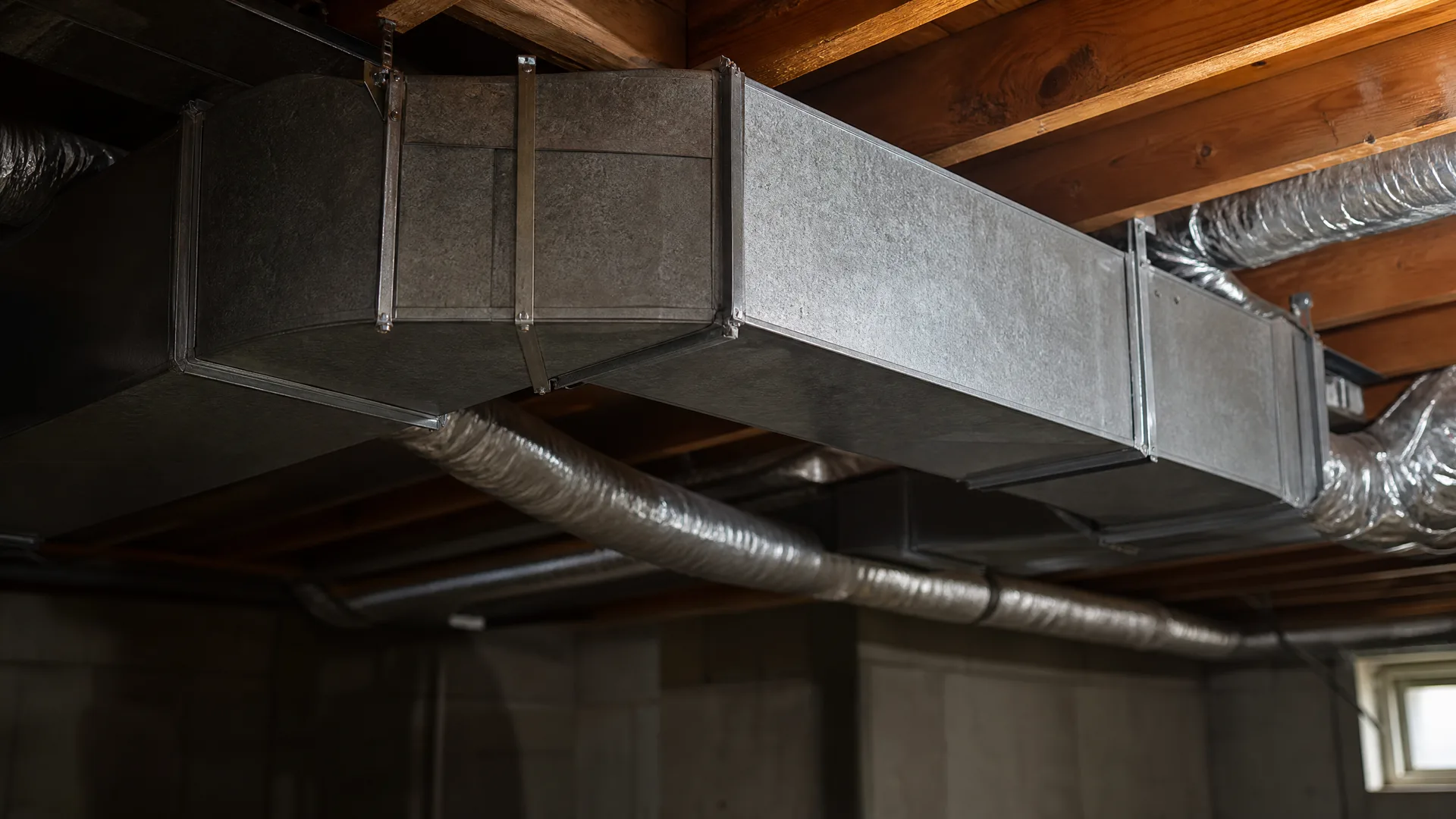
Unfinished basement with galvanized sheet-metal ductwork and pipes beneath wood joists, a gray furnace unit at left, insulated plastic-covered walls over a concrete foundation, and a bare concrete floor.
Metal ducts running clean along the joists, no dust trailing from the seams, air moving through without a smell.
Empty concrete-walled basement room with galvanized rectangular and round HVAC ducts and pipes running along the exposed wood-joist ceiling.
The same run coated along the bottom edge and furred with dust at every seam, a sign buildup has been sitting a while.
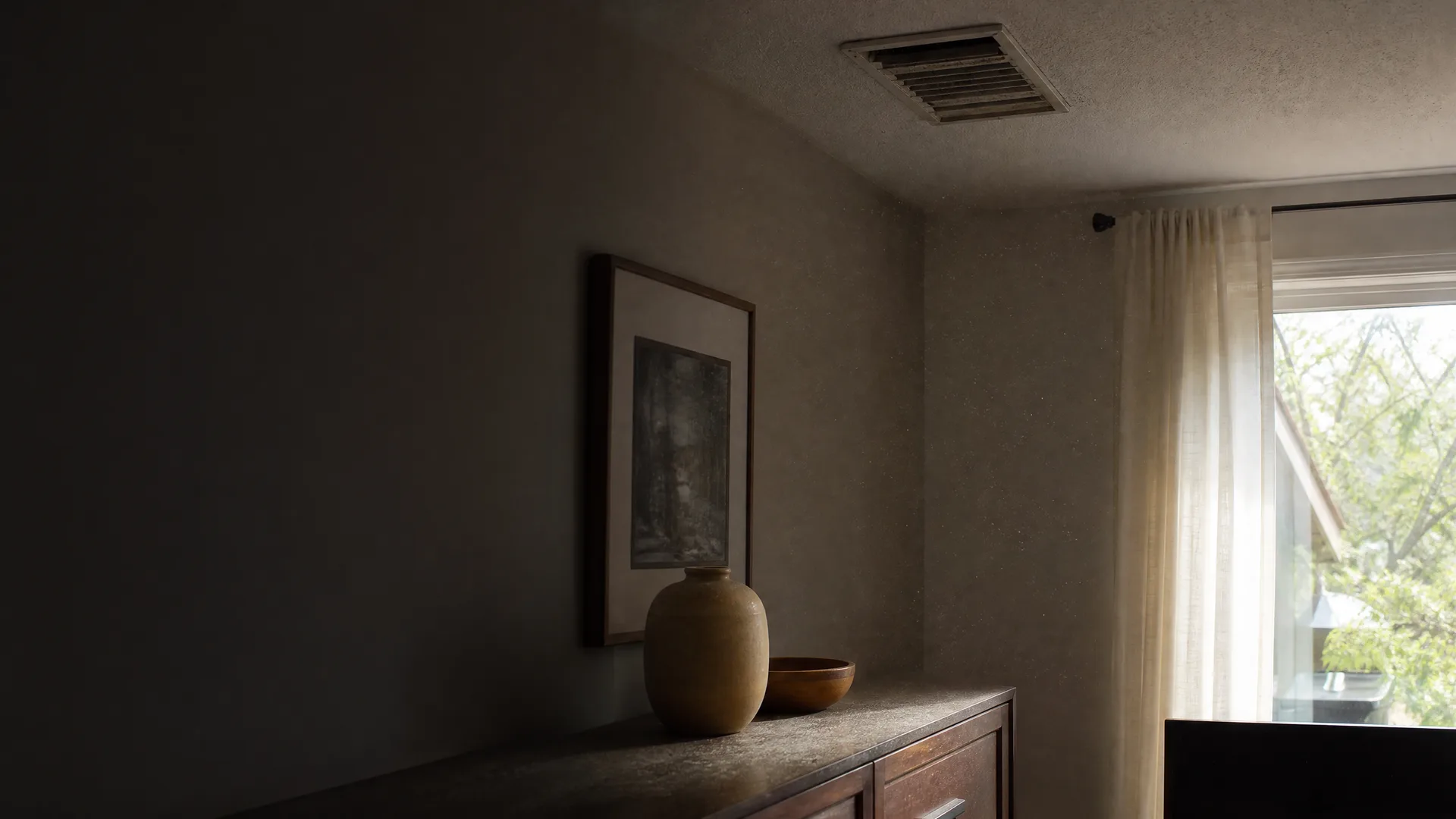
Dim room corner with a framed picture on a textured wall above a counter holding a tall ceramic vase and a shallow wooden bowl, with a sheer curtain beside a window and a ceiling air vent overhead.

It's a Saturday afternoon in April, warm enough that the AC has already kicked on a few times this week. You're vacuuming the living room and the sun's coming in low across the coffee table, showing a layer of fine dust on the wood you swear you wiped down a few days ago. You look up at the ceiling vent and there it is, a gray film across the grille and a faint ring spreading onto the ceiling around it. The register in the bedroom looked the same way last week. You wipe the table again, knowing it'll look like this by Tuesday, and start wondering who you'd even call to look at the ducts themselves instead of just the furniture.

Get matched with a duct system pro in Bexar County

The pro who gets in touch is licensed in Texas and works in Bexar County.

No fee to send it, and nothing to sign.

What duct work actually touches

Supply ducts, return ducts, the coils and the blower all get cleaned in the same job, because dust that sits in one part of the system moves through the rest of it once the blower runs. A thorough cleaning also covers the grilles and registers in every room, not just the main trunk lines behind the walls. Skipping the coil or the blower housing leaves a source of dust right where the air picks up speed on its way back into the house. That's why a cleaning that only vacuums the vents you can see often doesn't fix the resettling dust or the smell, since the parts doing the work never got touched.

What a clean system looks like after

After a real cleaning, a flashlight down the first few feet of a supply duct should show bare metal, not a gray film. The return grille, usually the biggest one in the house, should pull air without stirring up visible dust around the edges. The musty smell when the system kicks on should be gone the same day, since that smell usually comes from dust and moisture sitting in the ducts or on the coil. If the smell or the resettling dust comes back within a few weeks, something upstream, like a leaky duct seam pulling in attic air, is still feeding it.

Empty basement room with bare concrete walls and floor, with exposed wooden joists, sheet-metal HVAC ducts, an insulated flexible duct, and pipes running across the ceiling.
Before you get your ductwork cleaning
Empty unfinished basement with bare concrete walls and floor, showing galvanized sheet metal ductwork, insulated flexible duct, and pipes running along the wood-framed ceiling, with a small window at left.
After you get your ductwork cleaning

Skip it for now

No musty smell, no dust coming back fast, vents look clean when you check them. Keep an eye out, but there's nothing here pointing to buildup yet.

Get a licensed local pro

Get it looked at

Dust resettling in days, a musty smell on startup, or a dark ring at the vents. A local contractor who works on San Antonio duct systems can tell you what's actually in there.

Get a licensed local pro

Clean the Ducts or Hold Off

Clean the ducts

  • Dust is back on furniture or shelves within a day or two of wiping it down, even in rooms you keep shut.
  • You notice a musty smell for the first few minutes after the system starts, then it fades as air moves through the house.
  • Pulling a vent cover shows a layer of dust or a dark ring around the opening instead of bare metal.
  • Someone in the house is sneezing or stuffy more indoors than they are outside, with no other explanation.
  • A duct run you can see, like in the attic or a closet, is furred with dust along the seams or the bottom edge.
  • The system has been running most of the year, which gives dust more chances to build up and recirculate.

Hold off for now

  • Surfaces stay clean for a normal stretch after dusting, with nothing settling back within a day or two.
  • The air coming from the vents doesn't carry a smell when the system kicks on, whether it's been off for hours or days.
  • Vent covers look clean when you check them, with no dust ring or buildup around the edges.
  • No one in the house is dealing with more sneezing, coughing or stuffiness than they'd expect.
  • Any visible duct runs look the same as they always have, with no new dust trailing from the seams.
  • There's no recent reason to suspect buildup, like a renovation, pest problem or long stretch without a filter change.
  1. Dust and debris settle inside supply and return runs over time

  2. Air moving through the system stirs that dust back into each room

  3. A technician inspects the duct run and the coil for buildup

  4. Vents are sealed off one by one to contain loose debris

Power here costs 12.38 cents per kilowatt-hour

At 12.38 cents a kilowatt-hour, the blower pushing air through dirty ducts all summer isn't your biggest expense, but it's still running longer than it should when supply and return runs are coated with buildup. A clean system moves air with less work.

EIA-861 2025

Unfinished basement with exposed wood joists, galvanized sheet-metal ductwork, insulated flex ducts, piping, a small window, and a furnace or air handler against a gray wall.

Ductwork moving air clean

This is what a duct run looks like when it's doing its job. Air moves through the metal runs and out the vents without dragging dust along with it. No buildup at the seams, no haze inside the duct when you shine a light in, nothing settling back out once it reaches the room.

Empty basement room with bare concrete walls and floor, and an exposed ceiling of wooden joists with large galvanized sheet-metal ductwork and pipes.

Ductwork coated with buildup

This is the same kind of run after years of dust settling on the bottom edge instead of moving through. You can see it collecting along the seams and furring up where air barely reaches. Every time the blower runs, some of that gets pushed back out into the house.

A man with a duffel bag walks up a concrete path toward a white board-and-batten house where a woman stands in the open wooden front door, flanked by potted plants and black lanterns.

Where that leaves you

The signs don't take a technician to spot. Dust that resettles in a day or two, a musty smell when the system kicks on, a dark ring at the vent you can see with a flashlight. If you've noticed one of those, your ducts are telling you something. If you haven't, there's nothing here pushing you to act yet.

Bexar County has a lot of duct systems that have been running a long time without anyone looking inside them, and what's sitting in yours isn't something you can judge from across the room. A contractor who works on duct systems in this area all summer, season after season, knows what that buildup tends to look like by the time a homeowner calls, and where it collects first. Get matched with one who serves your part of San Antonio and you're dealing with a single local contractor reaching out to you directly, not a list of strangers working from the same lead.

A shallow dark wooden bowl and a stack of books rest on a wooden table in front of a beige sofa with linen and green cushions, with a tall ceramic vase of thin branches beside a window in the background.
Rectangular sheet-metal HVAC trunk ducting and insulated flexible ducts running along wooden floor joists in an unfinished basement ceiling above concrete block walls.

The right pro for this job

Duct and vent cleaningDucts or ventsBexar County, TX
Step 1 of 2

What ZIP code is the job in?