Texas HVAC Pros
A dark gray furnace with two access panels stands in a basement, connected to galvanized sheet-metal ductwork and PVC pipes, with exposed wood framing and a bare bulb light in the background.

Get your furnace to the right pro

How to lower your heating bill in a Texas winter

Most homes in Texas heat with electricity, so a furnace running harder than it needs to shows up fast on the bill. This page gets into what actually drives that cost up, and what a furnace tune-up can catch before it does. If you want a local contractor who works on furnaces like yours to take a look, you can ask below.

Find a pro near me

The fastest way to lower a Texas heating bill is to get your furnace running at the efficiency it was built for, because most of the extra cost comes from a furnace working harder than it should to hit the same temperature. A dirty filter, a weak flame sensor, or a blower motor pulling more amps than it needs will all do this quietly. You won't see a warning light. You'll see it on the bill. Since most homes here heat with electricity, every extra minute the furnace runs to make up for a small problem costs real money, even though power prices here aren't unusually high. A furnace that's clogged or out of tune can run considerably longer per cycle to heat the same house. Catching that early, before a cold snap forces the system to run nonstop, is what keeps the bill close to what it should be instead of climbing all winter.

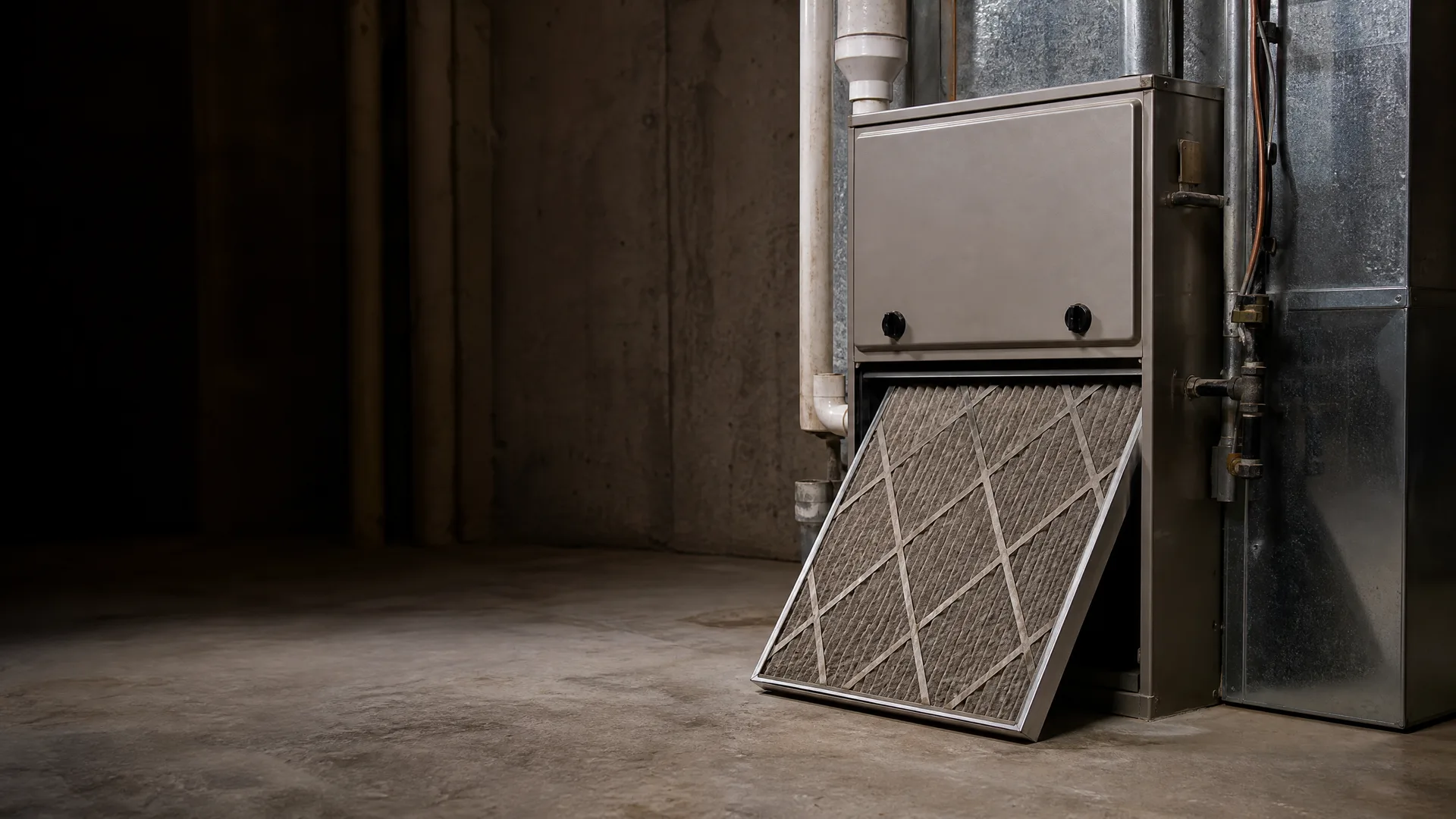
A dirty pleated air filter leans against a furnace with metal ductwork in a dim concrete basement.

You're down in the basement on a Saturday afternoon, the light coming in low through the one window, and you finally get around to checking the filter like you'd been meaning to. It slides out stiff, grey all the way through, dust packed into the pleats so tight you can't see light through it. You bought this place with the furnace already in it, so you don't know the last time anyone changed this. October in Texas doesn't ask much of it yet, just enough to take the morning chill off. You stand there holding it, thinking about what it's been pulling that much air through since summer, maybe longer.

A dark high-efficiency furnace on a concrete pad in a basement, connected to galvanized ductwork, white PVC vent pipes, and copper and black gas piping, with concrete walls and wood framing nearby.
A furnace that's been serviced burns clean and cycles on its own schedule, not fighting a clogged filter or a weak flame sensor.
A gas furnace with a louvered upper panel stands on a concrete pad in a basement, flanked by sheet-metal ductwork, white PVC and metal pipes, and insulated columns.
A furnace left alone runs longer to reach the same temperature, and that extra runtime shows up on next month's bill.

Is your furnace running longer than it used to?

You notice it in small ways first. The furnace kicks on more often, and it stays on longer before the house feels warm. The air coming out of the vents doesn't feel as hot as it did last winter. Maybe you hear it cycling through the night more than you remember. Some rooms stay cooler than others no matter how high you set the thermostat. None of this feels urgent on its own, but it adds up over a Texas winter, and since most homes here heat with electricity, that extra runtime lands directly on your bill. Left alone, a furnace working this hard tends to keep working harder, not less, as the months go on.

A beige high-efficiency furnace with white PVC vent pipes stands beside galvanized sheet-metal ductwork in a basement with a concrete floor, exposed wood studs, and metal piping along the wall.

Running the way it should

This is what a furnace looks like doing its job without a fight. The burners fire, the exhaust pulls clean through the PVC pipe, and the plenum sends warm air through the ducts on a normal cycle. Nothing here is working harder than it has to.

An older beige furnace with a louvered vent panel stands on a concrete basement floor beside galvanized sheet-metal ductwork, a metal flue pipe and vertical pipes along a concrete wall.

Running on borrowed time

An older furnace like this one can still heat the house, but it's carrying more years on the cabinet and the flue. A unit that vents through a metal flue pipe into block like this is worth a second look if it's the one you've had since you moved in.

A woman stands in the open doorway of a white stucco house holding the dark door, facing a man in a black cap and shirt seen from behind in the blurred foreground, with a potted flowering plant beside the entry.

What a tune-up actually checks

A gas furnace lights in a specific order. The inducer motor starts first and pulls air through to clear the exhaust line, then the igniter heats up, the gas valve opens, and the burners fire. The flame sensor watches that flame and shuts the gas off if it doesn't read fire within a second or two. Each step depends on the one before it. A tune-up walks that same sequence, checking the flame sensor for a buildup of residue, testing the igniter's resistance, and making sure the inducer is clearing exhaust the way it should before the burners ever light.

None of that shows up by looking at the furnace from across the room, which is why most homeowners never see the problem until the bill does. A local contractor who services furnaces all winter knows which of those steps tends to fail first in Texas homes, and in what order to check them. Getting matched with one contractor means one person looking at your system start to finish, not a different company each time something seems off.

Interior corner of a dining room with a round wooden table, a ceramic vase holding olive branches, a dark spindle-back chair near a curtained window, and a sideboard with a lamp against beige walls.
A woman with long gray hair wrapped in a checked blanket sits on a sofa by a window with yellow autumn foliage outside, with a lamp, framed picture and plant in the background.
An older woman in a cream knit sweater sits on a sofa by a window, looking out at sunlit trees with yellow and orange autumn leaves, with a bookshelf and lamp behind her.
A woman with gray shoulder-length hair in a dark knit sweater sits on a cushioned seat by a window, looking out at yellow autumn foliage, with a living room, armchair, houseplant and framed picture behind her.
An older woman with gray hair in a bun, wearing a cream knit sweater, sits on a sofa with a gray blanket and looks out a large window toward yellow-green autumn trees, with a lit table lamp and dark armchair behind her.

The right pro for this job

A furnace that's cycling too long isn't going to fix itself, and most people find that out partway through January when the bill arrives. Finding a contractor who actually knows gas furnaces, versus one who mostly does AC work, matters more in Texas than it seems like it should, since furnaces here run less of the year and a lot of companies don't see as many of them. The match here is local and it's one contractor, someone who works on furnaces in homes like yours every winter and knows what tends to go first, a flame sensor, a clogged filter, a cracked igniter. You're not stuck sorting through a handful of bids or fielding calls from companies who don't know your street. One contractor, already familiar with this equipment, reaching out to look at what's actually driving your bill up this winter.

A furnace that's short-cycled on a dirty filter can see its blower run twice as long to move the same amount of air through the house.

That extra runtime doesn't heat your house any faster. It just pulls more electricity to do the same job a clean filter would have done in half the time.

A gray furnace cabinet in a basement, connected to galvanized sheet-metal ductwork and white PVC pipes, against a concrete wall with exposed metal piping and insulation overhead.
Before you get your furnace maintenance
A gray high-efficiency furnace with two PVC vent pipes stands in an unfinished basement beside sheet-metal ductwork, a framed and plastic-covered wall, and a bare concrete wall with vertical pipes.
After you get your furnace maintenance
  1. The inducer motor starts and clears leftover exhaust from the line.

  2. The igniter heats up enough to light the gas.

  3. The gas valve opens and the burners fire.

  4. The flame sensor confirms a steady flame or shuts the gas valve.

A woman in a cream knit sweater sits in an armchair with her eyes closed and head tilted back, beside a window showing orange autumn foliage and a wooden side table with a mug.
A gray-haired man in a blue quarter-zip sweater sits in an armchair with his eyes closed, beside a large window with bare trees outside and a potted plant and lamp nearby.

Winter nights average 41°F statewide

Nights here average 41°F through December, January and February, not the hard freezes you get further north. That means your furnace is cycling on and off most winter nights rather than running flat out, so a part that's not firing right gets more chances to waste power over the season.

NOAA nClimDiv 1991-2020 county normals weighted by homes

What this comes down to

  • A furnace running clean cycles on its own schedule instead of pushing longer to hit the same temperature.
  • Checking the filter, the flame sensor, and the burner cycle catches the parts of your winter bill that a clogged system quietly adds.
  • Mild Texas nights mean your furnace cycles on and off often, so a part that's not firing right gets tested more, not less.
  • A local contractor who works on gas furnaces all winter knows which parts tend to fail here before they strand you on a cold morning.
  • You get matched with one contractor suited to your furnace and your part of Texas, not a list of companies competing for the call.
  • Nothing about how your furnace runs changes until the part causing it to work harder gets found and fixed.

A furnace that's running right doesn't fight itself to hit the temperature on your thermostat. It fires, cycles, and shuts off on its own schedule, and your bill reflects that instead of reflecting a clogged filter or a flame sensor that's not reading right. That's the whole answer. Everything above this is about finding which part is causing the extra runtime, because the furnace won't tell you on its own. It just keeps running longer, night after night, until the bill shows up.

Texas winters make this easier to catch than you'd think. Nights in the 40s mean your furnace is cycling on and off most of the night rather than running flat out for hours, so a weak part gets tested over and over instead of just once. That's more chances for a problem to show itself during a tune-up, before it leaves you without heat on the one morning it actually drops near freezing.

Finding the part worth fixing is a job for someone who works on gas furnaces through the winter, not someone who spends most of the year on AC calls. When you request a match, you get one local contractor suited to your furnace and your part of Texas, not a handful of companies calling you back. That contractor shows up knowing what tends to fail in furnaces like yours after a season of Texas nights, because that's what they've been working on all winter.

A dimly lit unfinished basement with concrete walls and floor, exposed floor joists, a small window at left, and a dark furnace with PVC venting and sheet metal ductwork at right.

Matched to your furnace job

Your request goes to one pro, not a list of companies.

Tune-up, service, or cleaningFurnace or heatingTexas
Step 1 of 2

What ZIP code is the job in?